A.E. Williams Review: 380 Years of Hand-Cast Pewter
Most heritage brands count their age from when a founder signed a lease or filed a patent. A.E. Williams counts theirs from a spoon mould found at the bottom of a well.
In 1642, during the English Civil War, a Williams ancestor hid their pewter-casting moulds in a well — presumably to prevent them being melted down for ammunition. Those moulds were recovered, and they are still in production today.
The company was formally established in 1779, making it 247 years old by that measure. But the craft itself — hand-casting pewter in Birmingham — has been in the Williams family for over 380 years and seven generations.
The Heritage
A.E. Williams is the world's oldest family-run pewter manufacturer. They are also, remarkably, the only company besides the Royal Mint to have made coinage for the Crown in the last 500 years.
Their workshop sits in Birmingham, part of the same metalworking tradition that produced Deakin & Francis (cufflinks, est. 1786) and William Mitchell (pen nibs, est. 1822). The city's Jewellery Quarter and surrounding areas have been the heart of British metalcraft for centuries.
Heritage Crafts classifies pewter working as Endangered. The number of skilled pewter smiths in Britain continues to decline, and the craft lacks the training infrastructure to replace retiring workers.
On Screen
Most people have seen A.E. Williams' work without knowing it. The Digbeth workshop cast the goblet Petyr Baelish drinks from in Game of Thrones, the tankards Johnny Depp uses in Pirates of the Caribbean and Sweeney Todd, and the plates and chargers laid across the tables of the Great Hall in the Harry Potter films. Every piece leaving the workshop is still marked with the individual maker's personal stamp — the same practice that lets a prop department, or a customer, trace a goblet back to the hands that cast it.
Staying in Digbeth
Four descendants of Thomas Williams still run the business from a factory on Well Street they've owned since 1972 — currently the seventh and eighth generations. Digbeth has changed around them: new bus gates and altered roadways make it harder for delivery lorries to reach the workshop, and the neighbourhood's redevelopment into residential towers means it's no longer the industrial centre it once was.
The family stays anyway. Steve Williams, who runs the business today, says it comes down to the people: A.E. Williams doesn't hire seasonal staff for Christmas just to let them go after — they grow slowly instead, to keep their small team in secure, permanent work. When an antique tool breaks down, they call retired staff who still remember how to run it. The company holds the largest collection of pewter moulds in the world, some dating to the 1700s, still sitting on the factory floor in daily use.
The Craft
Every A.E. Williams piece is hand-cast by master pewter smiths using traditional methods:
- Mould Preparation — Many moulds are antiques, some dating back centuries. New designs are carved by hand from steel or bronze
- Alloy — A.E. Williams uses a fine alloy of 92% tin, 6% antimony, and 2% copper. 100% lead-free — a distinction that matters for drinkware and food-contact pieces
- Casting — Molten pewter is poured into moulds by hand, requiring precise temperature control
- Fettling — Excess metal is trimmed and seams are smoothed
- Spinning — Flat pieces are shaped on a lathe using hand pressure against wooden formers
- Polishing — Each piece is polished to a mirror finish or given a satin texture, depending on the design
- Engraving — Many pieces receive hand-engraved decoration or personalisation
The result is a material that feels unlike anything mass-produced. Pewter has a warmth and weight that aluminium and stainless steel cannot replicate. It develops a soft patina over time that many collectors prize.
The Product Range
A.E. Williams produces an extraordinary range of pewter goods:
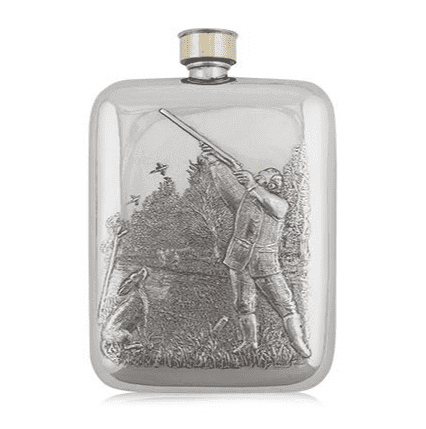
- Hip Flasks — Their bestselling category, from classic plain designs to ornately engraved pieces
- Tankards & Goblets — Traditional drinkware, often bought as christening or wedding gifts
- Measures — Spirit measures and thimble measures, many using antique moulds
- Jewellery — Celtic and contemporary designs cast in fine pewter
- Collectibles — Figurines, trinket boxes, and commemorative pieces
Prices are accessible for handmade metalwork — hip flasks from £20, tankards from £40. The combination of heritage, hand-craftsmanship, and reasonable pricing makes them exceptional value.
The Verdict
A.E. Williams has one of the most extraordinary origin stories in British manufacturing. A 380-year lineage. Moulds hidden during a civil war. Coinage for the Crown.
But beyond the heritage, there's a business that works. They've found the sweet spot between traditional craft and commercial viability, producing hand-cast pewter at prices that compete with mass-produced alternatives.
In a directory full of old firms, A.E. Williams may have the oldest story of all.
Pros:
- 380+ year heritage — possibly the oldest craft lineage in our directory
- 100% hand-cast, lead-free pewter
- Accessible pricing for genuine hand-crafted metalwork
- Part of Birmingham's endangered metalworking tradition
- Props for Game of Thrones, Harry Potter, and Pirates of the Caribbean cast in-house
- Deliberately doesn't hire and lay off seasonal staff — grows slowly to protect permanent jobs
Cons:
- Pewter is a niche material — not for everyone
- Some designs lean traditional/conservative
- Well Street factory is increasingly hard to reach as Digbeth redevelops around it
Related: Deakin & Francis Review | William Mitchell Review