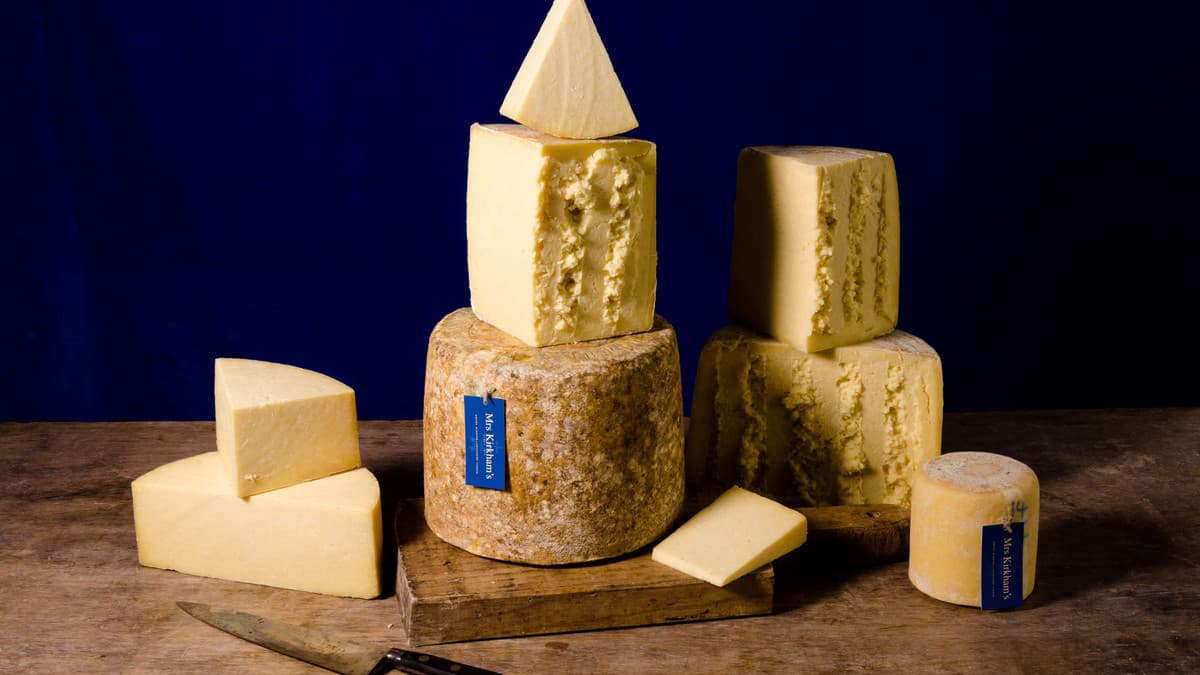
Kirkham's Lancashire Review: The Last of 202
In 1939, there were 202 farms and dairies making traditional raw-milk Lancashire cheese. Today there is one. That is not a rounding-error kind of decline. That is a category collapsing from a genuine regional industry down to a single working farm, inside a single lifetime.
Kirkham's Lancashire, made on the family farm in Goosnargh, is the sole survivor of an entire county's cheesemaking tradition — not the best of a shrinking field, but literally the last one standing. Three generations of the Kirkham family have kept it that way, through a period in which raw-milk cheesemaking went from a normal regional trade to something close to extinct.
The Story
Lancashire cheese was, for most of the county's history, a genuinely common regional product — made on hundreds of small farms across the county as a way of using surplus milk, much like cheddar in Somerset or Cheshire in Shropshire. By 1939, on the eve of the Second World War, there were still 202 farms and dairies producing it the traditional way. That number matters as a baseline: it shows this wasn't ever a rare, niche product. It was ordinary farmhouse food, made widely, by people who'd learned the method from the generation before them.
What happened next is the same story that plays out across almost every traditional British food category in the twentieth century: wartime regulation pushed dairy farms toward standardised production for rationing, post-war industrialisation rewarded speed and shelf-stability over flavour and process, and the economics of running a small raw-milk dairy became steadily harder to justify against the alternative of selling milk wholesale or converting to pasteurised, factory-style production. One by one, the 202 fell away. Kirkham's, on the family farm in Goosnargh, did not.
What Makes It Different
Traditional Lancashire is what's called a "two-day curd" cheese — made by combining curds from two, sometimes three, separate days' milking, a labour-intensive method that gives it a crumbly, buttery texture unlike almost any other British cheese. Kirkham's still makes it this way, from unpasteurised milk from their own herd, using methods essentially unchanged from before the Second World War.
Pasteurisation kills off more than pathogens — it flattens the complex bacterial and enzymatic activity that gives raw-milk cheese its depth and variation from batch to batch. Industrial "Lancashire-style" cheese, made from pasteurised milk with standardised starter cultures at a factory that may not even be in Lancashire, can legally use the name but cannot replicate what happens when raw milk from a specific herd, on a specific farm, is turned into two-day curd by people who have done nothing else for three generations.
The two-day curd process itself is part of why so few producers persisted with it even before pasteurisation became the norm. Combining curds from separate milkings, rather than working with a single day's batch, requires careful timing, temperature control, and judgement that can't easily be reduced to a fixed schedule — it's a technique that rewards experience built up over years rather than a process that scales cleanly with automation. That's precisely the kind of method that gets quietly abandoned first when a business is looking to cut cost or simplify production, because it's slower and harder to standardise than almost any other stage of cheesemaking.
Why the Numbers Matter
Going from 202 makers to one isn't a story about quality decline — it's a story about what it costs to keep doing something the hard way once industrial alternatives exist. Raw-milk cheesemaking carries regulatory burden, slower production, and none of the shelf-stability of pasteurised, factory-standardised cheese. Every one of those 201 other Lancashire cheesemakers made a rational economic decision to stop, modernise, or fold into a larger dairy operation. Kirkham's didn't.
That makes Kirkham's less a heritage product than a living population of one — if this farm stops, traditional raw-milk Lancashire cheese, as a category, ends with it. There is no second producer to fall back on, no wider industry to absorb the loss. This is precisely the kind of quiet, total disappearance this site exists to flag before it happens, not after.
It's worth being clear about what "the last one" actually means here, because it's easy to read past a statistic like 202-to-1 without registering its weight. It doesn't mean Kirkham's is simply the best of several remaining options, the way you might describe the last surviving manufacturer of a niche industrial component that a handful of firms still compete to make. It means that if this specific family farm in Goosnargh were to close tomorrow — for any reason, retirement, ill health, an unfavourable regulatory change, a bad season — there would be no traditional raw-milk Lancashire cheese made anywhere in Britain by the following morning. Not a diminished supply. None.
What You're Really Buying
A wheel or wedge of Kirkham's costs more than a supermarket block of "Lancashire" cheese, and it should — it takes longer to make, uses milk with none of pasteurisation's shortcuts, and comes from a herd and a farm you could, in principle, visit. What you're buying is the last surviving example of a cheesemaking tradition an entire county used to practise, made by the only family left who still knows how.
You are also buying insurance, in the loosest possible sense — a reason for the last Lancashire cheesemaker to keep being the last Lancashire cheesemaker, rather than the final one. Every wheel sold is direct, unambiguous evidence to the farm that there's still a market for doing this the hard way, which matters more here than it would for a producer with competitors to absorb the demand if Kirkham's ever scaled back.
Pros:
- Genuinely irreplaceable — the only maker of traditional raw-milk Lancashire cheese left in existence.
- Two-day curd method and raw milk give a depth and texture no pasteurised "Lancashire-style" product can match.
- Three generations of unbroken family expertise in a single, very specific craft.
Cons:
- Raw-milk cheese requires more careful storage and has a shorter practical shelf life than pasteurised alternatives.
- Limited production volume means it's not always easy to find outside specialist cheesemongers and farm shops.
- Because "Lancashire" isn't a protected name, shoppers have to specifically seek out Kirkham's rather than trusting the label alone.
The Industrial Comparison
It's worth being specific about what "Lancashire-style" cheese elsewhere actually is, because the naming confusion is part of the problem. Under current food labelling rules, a cheese can be sold as "Lancashire" without being made in Lancashire, without using raw milk, and without following the two-day curd method — the name describes a general style rather than a protected process or origin, unlike the Melton Mowbray pork pie's hard-won PGI status. That means a shopper picking up a block labelled "Lancashire cheese" in a supermarket has no reliable way of knowing whether they're buying anything connected to the actual county or its traditional method at all.
This is exactly the kind of gap that leaves producers like Kirkham's vulnerable in a way that goes beyond ordinary market competition. A shopper who doesn't know to look for Kirkham's by name might reasonably assume any "Lancashire cheese" on the shelf represents the tradition, when in most cases it doesn't. The absence of protection doesn't just risk undercutting Kirkham's on price — it actively obscures the fact that there's a real difference to look for in the first place.
The Verdict
Kirkham's Lancashire is what's left when an entire regional food tradition narrows down to a single farm. That's not a comfortable statistic, but it is an honest one, and it's exactly why this cheese belongs in the same conversation as any endangered craft on this site — a shuttered pottery kiln or a lost cutlery forge gets documented and mourned; a cheesemaking tradition quietly narrowing from 202 farms to one has, until now, gone almost entirely unremarked outside specialist food circles. Buying it is one of the few direct, immediate ways to keep a genuinely singular tradition from ending on your watch, rather than reading about its end after the fact.
Read more about why traditions like this one need active protection in British Real Food Heritage.
Related: Montgomery's Cheddar Review | Appleby's Cheshire Review