
Before You Sell: A Founder's Guide to Keeping Your Firm Independent
If you run a British heritage manufacturer, someone is going to approach you eventually — a private equity fund, a larger group in your sector, a family office, or simply an offer that solves a succession problem you've been putting off. This isn't a piece telling you not to take the call. It's a piece written from the record of nine firms who took the call and lost their independence, and several more who took a similar call and didn't. The difference wasn't luck. It was structure, and it was mostly decided before anyone signed anything.
The pattern that costs independence
Every disqualifying case we found shared the same shape: a majority stake changed hands to an entity whose accounts are consolidated somewhere else, whose board answers to shareholders who've never seen your workshop, and whose commercial logic is return on the group's capital — not the continuation of your craft for its own sake. That's it. Everything else — whether the buyer promised to keep the factory open, keep the family name over the door, keep the creative director in place — is negotiable after the fact, because none of it is what actually changed hands. What changed hands was the vote.
Freed of London, Heathcoat Fabrics, Lochcarron, Swaine, Abraham Moon, Grenson — every one of them still looks, on the surface, exactly like it did before. That's not an accident; it's the buyer's entire strategy. The visible things were never what they were buying.
What kept the other firms independent
Buy it back. Cheaney was owned by Prada, via Church & Co, from 1999 to 2009. Two family cousins — fifth-generation descendants of the founding Cheaney line — executed a full management buyout in 2009 and rebuilt it as a genuinely independent firm. This is the strongest precedent in the whole audit: independence lost to a conglomerate is not necessarily independence lost forever, if the people who care enough are willing to buy it back rather than just work for the new owner.
Take capital without giving up the vote. Emma Bridgewater took £8m from BGF in 2020 and a further £2.2m in 2024 — real, meaningful outside capital — but structured as a minority investment. The founder and family retained board control and majority equity throughout. The lesson: the amount of money isn't the disqualifying factor. The percentage of the vote is.
Choose a syndicate over a conglomerate, and check what it actually owns. When Burleigh's parent, Denby Holdings, went into administration in March 2026, Christopher Bailey (former Burberry CEO) didn't buy Burleigh as a line item in a larger group's portfolio — he formed a private investment syndicate specifically to acquire it, and took direct executive leadership himself. Tricker's, similarly, moved to a private craft syndicate (Blu Heartknot UK) rather than a public company when the Barltrop family exited in 2025. Neither is family-owned anymore. Both are still independent, because the buyer's whole commercial logic remains "run this well as itself," not "consolidate this into something bigger."
Understand what you're actually selling if you sell the trademark abroad. John Lobb's 1976 split with Hermès is the cleanest cautionary tale in reverse: the Lobb family sold the international trademark and a manufacturing operation abroad, but kept the original London bespoke workshop entirely separate and entirely their own. Structured correctly, a sale doesn't have to mean losing everything — but it does mean being extremely precise, in the paperwork, about exactly what's being sold and what isn't.
Questions worth asking before you sign anything
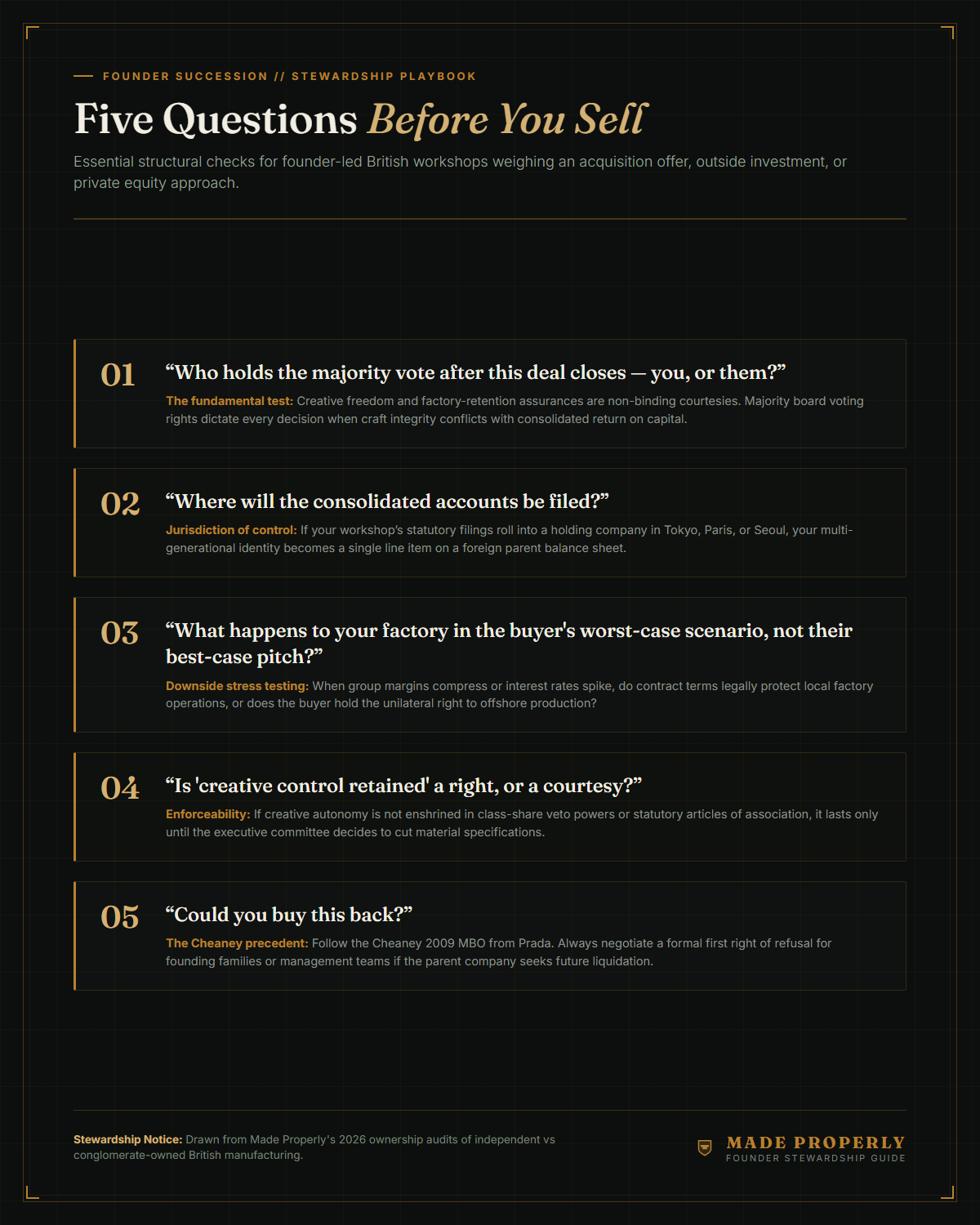
Figure 1: Essential structural questions for founder-led British workshops weighing an acquisition offer or succession transaction.
Who holds the majority vote after this deal closes — you, or them? Not "who runs day-to-day operations," not "who's the public face," not "who keeps their name on the door." The vote. If the buyer holds 51% or more, every promise made during the negotiation is unenforceable the day the deal closes, because they don't need your agreement to change their mind. This is exactly what happened at Cadbury with the Somerdale factory promise, and it's the single most important lesson in the entire history of heritage-brand acquisitions.
Where will the consolidated accounts be filed? If the answer is a country you don't operate in, you are now a line item in someone else's balance sheet, and decisions about you will be made in the context of that whole balance sheet — including decisions about whether to keep manufacturing in Britain at all, when a cheaper option exists elsewhere in the group.
What happens to your factory in the buyer's worst-case scenario, not their best-case pitch? Every acquisition pitch describes the best case. Ask what the buyer's standard playbook is when a portfolio company underperforms — relocate production, cut the workforce, license the name out and close the factory. If they won't answer specifically, that's the answer.
Is "creative control retained" a right, or a courtesy? A courtesy can be withdrawn the day the person offering it changes their mind, is replaced, or is overruled by their own board. A right is written into the shareholder agreement, with real consequences if it's breached. If your lawyer hasn't seen the exact clause, you don't have it yet — you have a verbal assurance, which is worth exactly as much as Kraft's Somerdale promise turned out to be worth.
Could you buy this back? Not "would you want to" — could you, structurally, financially, ever get to majority control again if the new ownership turned out badly? Cheaney's story only exists because a management buyout was possible. If the deal structure makes a future buyback effectively impossible (cross-shareholdings, non-competes, IP retained entirely by the buyer even if the operating company is later sold on), that's worth knowing before you sign, not after.
If you're not selling, but you are struggling
Not every firm in this position is fielding acquisition offers — some are just under real pressure: energy costs, an ageing workforce, a succession gap with no obvious buyer inside the family. If that's where you are, a corporate sale isn't the only route, and it's rarely the best one for keeping what actually matters. Dartington Crystal's management buyout and the several employee- and management-led rescues in this audit show there's usually a version of "keep going independently" available, even from a genuinely difficult starting position — it just takes structuring the deal around keeping the vote, not just keeping the name.
If it would help to talk through what that could look like for your business specifically — not a sales pitch, a genuine conversation about the options — we're glad to have that conversation. We built this directory because we want firms like yours still trading in a hundred years. Staying independent is, on the evidence in front of us, the single best predictor of whether that happens.