The Corporate Wolves in Craft Clothing: Nine Heritage Brands That Aren't Independent Anymore
We built this directory on one rule: every firm in it is independent, family-owned, founder-led, or a cooperative — not a subsidiary, not a conglomerate brand, not a name kept alive by a holding company because the story still sells. This week we checked our own list against that rule properly, for the first time since April, using Companies House filings and statutory ownership records rather than trusting the marketing copy. Nine firms failed. Some of them had been in the directory for months.
This isn't a story about villains. Nobody at these companies is lying, exactly — the goblet is still hand-cast, the tweed is still hand-woven, the person who answers the phone still cares. What's changed is who gets the profit and who makes the decisions when the two conflict. That's the part the marketing never mentions, and it's the part that actually matters.
The mechanism
A heritage brand's most valuable asset is a story: founded in [year], still in the family, still made the old way. That story survives an acquisition perfectly intact, because nobody's paying for the factory — they're paying for the story. The buyer's entire commercial logic is to change nothing visible while extracting everything invisible: consolidated accounts, board control, the right to move production if the numbers ever stop working.
So the website doesn't change. The "About" page still says "family business since 1868." The Instagram bio is untouched. What changes is a line in a statutory filing nobody reads, thousands of miles from the workshop, saying who actually owns the company — and that filing is the only place the truth survives the acquisition uncorrupted.
Nine firms, four continents of ownership
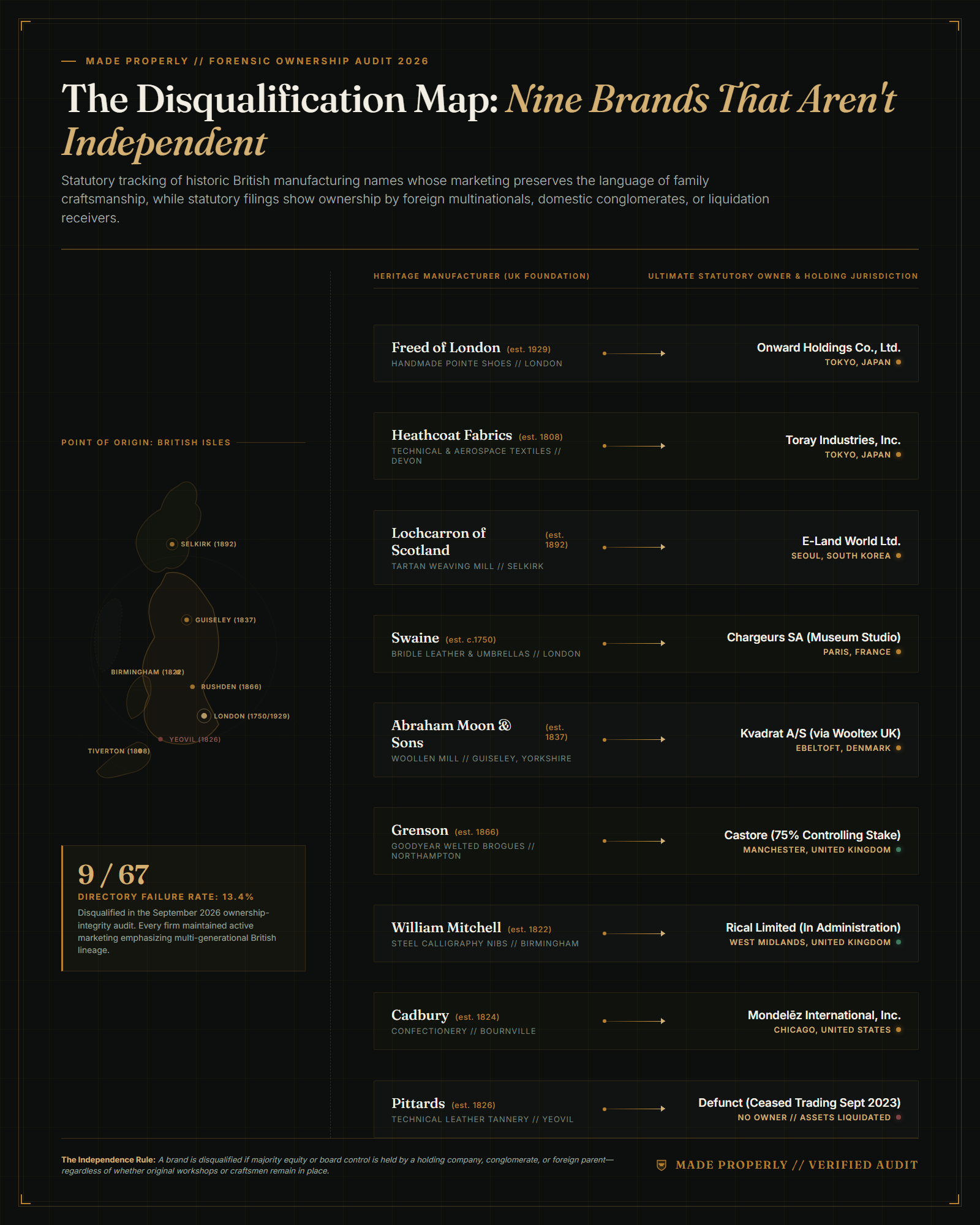
Figure 1: Statutory tracking of nine historic British manufacturing names answering to foreign parent corporations, domestic holding groups, or insolvency receivers.
Freed of London — hand-cutting pointe shoes for the world's ballet companies since 1929 — has been a wholly owned subsidiary of Onward Holdings Co., Ltd., a Tokyo Stock Exchange-listed Japanese apparel conglomerate, since 1993. Onward's dance subsidiary Chacott Co. sits above Freed in the ownership chain. The shoes are still hand-made in London and Leicester. The consolidated balance sheet is filed in Tokyo.
Heathcoat Fabrics — the Devon mill whose bobbinet lace machine John Heathcoat patented in 1808, and which later supplied technical fabric for aerospace and NASA's Mars rover parachutes — is a wholly owned subsidiary of Toray Industries, Inc., the Japanese industrial materials and synthetic fibre multinational.
Lochcarron of Scotland, the world's largest commercial tartan weaver, stopped being family-owned in 2011, when the Buchan family sold 100% of the share capital to E-Land Group, a South Korean retail and manufacturing conglomerate operating via E-Land World and E-Land Retail.
Swaine, trading since roughly 1750 and once supplying leather goods to the Indiana Jones production, was acquired out of administration in 2020 by Chargeurs SA, a publicly traded French luxury-materials conglomerate listed on Euronext Paris. It now sits inside a division Chargeurs calls its "Museum Studio" brand portfolio — a phrase that tells you almost everything about how the parent company thinks of it.
Abraham Moon & Sons, the Yorkshire wool mill in Guiseley since 1837, ended a century of Walsh family ownership in August 2020 when it was bought by Wooltex UK Ltd — itself majority-owned by Kvadrat A/S, the Danish design-textile corporation.
William Mitchell Calligraphy, hand-cutting steel nibs in Birmingham's Jewellery Quarter since 1822, isn't foreign-owned — its problem is worse. Its manufacturing infrastructure sits inside the Rical Group, an industrial engineering conglomerate that entered formal administration in January 2025. We've suspended the listing rather than removed it outright, pending whatever comes out the other side of that administration.
Grenson, the Northampton brogue-maker founded in 1866, is the newest and most local case: in June 2026, sportswear group Castore acquired a 75% controlling stake. Castore itself has since confirmed it's fielding takeover approaches from international banking syndicates — meaning Grenson is now two ownership layers removed from anyone actually making the shoes, with a third potentially incoming.
Two more names round out the nine: Cadbury (owned by Mondelez since the 2010 Kraft takeover — we've told that story in full elsewhere) and Pittards, the Somerset leather tannery that ceased trading permanently in September 2023 and remains in administration solely to liquidate its assets. Different failure mode — insolvency, not acquisition — but the same result: a name that no longer describes a going, independent concern.
The three firms that don't belong on this list, even though they look like they should
John Lobb is the case that will trip up almost anyone checking casually. In 1976, the Lobb family sold the international trademark and a French manufacturing operation to Hermès, which built a mechanised ready-to-wear factory in Northampton and now trades globally as John Lobb SAS. But that deal only ever covered the trademark abroad. John Lobb Limited, the original 1849 bespoke workshop at 9 St James's Street, London, was never part of it — it's still run by the fifth generation of the Lobb family, still hand-lasts every pair to individual measurements, still holds its own Royal Warrants, and trades through its own website, johnlobb1849.com. Two companies, same name, same founding family on one side only. We had this wrong in our own directory until this audit — the listing described the Hermès-owned positioning ("Luxury Ready-to-Wear") rather than the bespoke workshop. It's fixed now, with the distinction spelled out.
Tricker's genuinely changed hands — five generations of Barltrop family ownership ended in July 2025, confirmed in Companies House filings, with a 71% stake now held by a private syndicate, Blu Heartknot UK. But a private craft syndicate retaining the existing works and creative direction is a different animal from a public conglomerate's subsidiary. It stays in the directory, reclassified rather than removed.
NPS Solovair stopped being the workers' cooperative it was founded as — in 2006, not last week. It's now a private, family-run firm under Ivor and Jennifer Tilley. If your mental model of Solovair is still "cooperative," it's twenty years out of date, and so, until this week, was ours.
What this means if you're trying to buy independent
The uncomfortable finding isn't that nine firms out of 67 failed — it's that the failure was invisible from outside. Every one of these companies' own marketing, packaging and "About" pages read exactly like the firms that passed. The only place the truth was recorded was in ownership filings none of us read by habit.
That's not a reason to give up on buying independent. It's the reason to check properly rather than trust the story on the tin — which is exactly what we've now written up as our own audit method, so you can run the same check yourself on anything you're not sure about.
And if you're a heritage firm weighing a sale, or already fielding an approach: the difference between what happened to Cheaney (bought back into full independence from Prada in a 2009 management buyout) and what happened to Grenson is a set of specific, answerable questions, asked before signing rather than after. We've written those out too.